If You Melt Baking Chocolate Will It Harden Up Again After
What is more luxurious than a pool of perfectly polish, perfectly ready-to-practice-your-bidding chocolate? One that will glaze whatever you want, and harden almost instantly to a shiny, firm-to-the-touch surface that snaps when you break it?
Jenn Bakos
Our honey thing with chocolate is never-ending, but equally in all good relationships, there are some things that piece of work and some that just... don't. The wise person knows all they can about their truthful dearest, and accepts that certain behaviors get better results. That's why knowing well-nigh tempering chocolate is of import.
Sure, you lot tin cook chocolate chips or those melting discs you see at the store and coat things, only the flavor and texture aren't quite what true chocolate apprecianados are looking for. Kind of like dating the brother of the guy you're really interested in.
The office of chocolate that allows it to cook so sumptuously in your oral cavity is cocoa butter, and it's made of a family of crystals (half dozen types altogether). What makes working with chocolate tricky is each blazon of crystal forms or sets at a different temperature, and some of those forms aren't very stable; they can modify over time and in storage.
Jenn Bakos
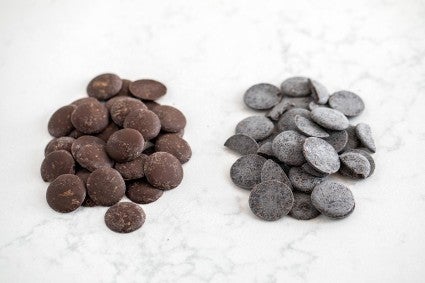
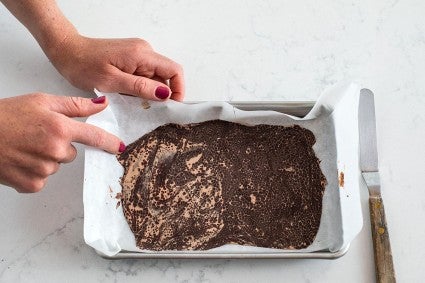
When chocolate gets also warm, but not warm plenty to melt, some of the cocoa butter crystals tin drift to the surface; this dusty-looking chocolate has "bloomed." It's fine to eat or bake with, only it'south no longer "in temper."
Jenn Bakos
Existent chocolate vs. candy coating
Before we go to tempering, we need to explain what is and isn't chocolate.
Jenn Bakos
- Candy coating/candy melts/summer blanket are made of carbohydrate, milk solids, vegetable oils, flavorings and colors; for "chocolate" flavors, you'll likewise discover some cocoa powder. The great virtue of these things is their convenience. Cook, dip whatever (block pops come to mind), allow them set at room temperature. Their almost impenetrable usability is commencement past a waxy feel in the oral fissure, and equally for flavor? Meh. Kids like them, partly because you'll find them in a wide range of colors. But they're not chocolate, and therefore, not for me.
- Chocolate chipsare chocolate that has soy lecithin added to it to enhance its melting temperature, so the chips hold their shape when baked. This increase in melting temperature makes them a little trickier to coat things with, which is why nosotros apply them to brand the adjacent blazon of chocolate ...
- Dipping chocolate commonly chocolate chips with some shortening added, nosotros've used this many times to coat things in our recipes. Ratio: i tablespoon shortening for each cup (170g) of fries. This formula doesn't gear up as firmly as tempered chocolate volition, and on a hot 24-hour interval you may demand to put whatsoever yous've dipped into the refrigerator for a chip, simply it'due south perfectly serviceable for blanket those pretzels, Oreos, or snack cakes.
What are the percents on chocolate labels?
To quote Chef Peter Greweling, CMB, from his fantabulous book Chocolates & Confections, "But put, the percentage listed on a label describes the portion of the chocolate that came from the cacao tree. The percentage of chocolate represents the combination of chocolate liquor [chocolate (cacao) solids] and cocoa butter, but fails to differentiate between them. As a result, two chocolates, each of them labeled 65%, can be radically unlike from each other."
Which brings the states to:
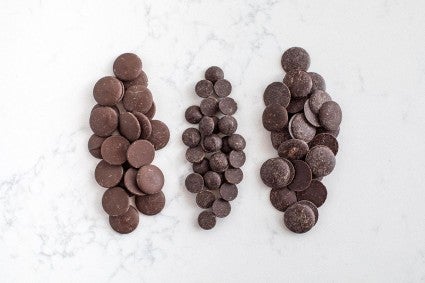
- Couverture. For dipping and coating, this is the stuff you're afterwards. Our couverture chocolates are from Guittard (semi-sweet disks, 61%); Valhrona (bittersweet discs, 62%) and Belcolade (bittersweet disks, 57.viii%). As Chef Greweling states in a higher place, the percent indicates cacao mass; for couvertures, the ratio of cocoa to cocoa butter favors the latter. More cocoa butter means the chocolate will be thinner when melted, and therefore coat or curtain more than easily. You lot can temper and coat with about any chocolate, including semisweet, milk, or white; they just need slightly different handling, by and large regarding temperatures.
Methods for tempering chocolate
There'due south more than i way to temper chocolate. One of them is chosen tabling.
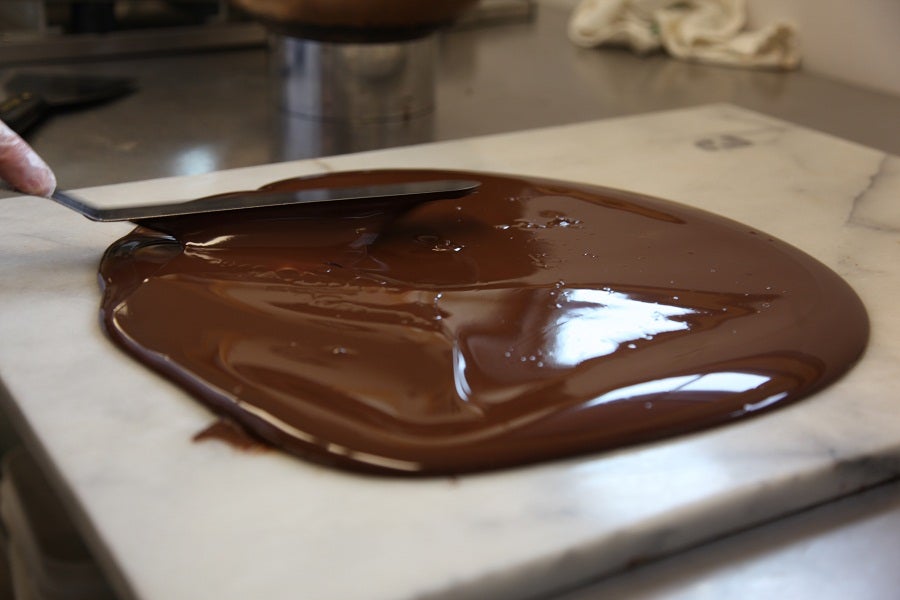
Chocolatiers like this method because it's efficient, and they get an immediate feel for how the chocolate is behaving. An corporeality of chocolate is melted, then 2/3 of it is spread on a make clean marble slab and moved around to cool information technology until it starts to thicken. This paste is added back to the remaining melted chocolate to "seed" it; one time tempered it's held between 86°F and 90°F and ready to use. Tabling is a wonderful method to use, provided you have lots of space and a large block of marble hanging around. Moving it around is kind of hypnotic.
At that place'south also an approach typically reserved for those with lots of experience working with chocolate: it'southward called the directmelt method. Past very carefully melting and stirring the chocolate and keeping information technology within specific temperature ranges, chocolate can be kept in atmosphere the whole fourth dimension. It'southward catchy to do, and takes some exercise.
For many home bakers though, the nigh practical method of tempering chocolate is a process called seeding. Even the renowned pastry chef Roland Mesnier joked about the tabling method, saying "Who has time for that these days?" He used the seeding method when teaching a grade at our Baking School, too, so don't think this method is inferior in the least.
Seeding is uncomplicated in one case you know the basic tenets and temperatures to guide your work. Let's dive in.
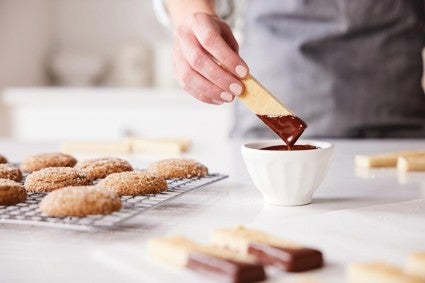
Kristin Teig
What tools do you need to temper chocolate by seeding?
An accurate digital thermometer is important.
A bowl, a spatula to stir with, a saucepan with an inch of water in it, or a microwave to melt the chocolate. Parchment newspaper to place your cooling chocolates on. Depending on your project, you may want dipping tools, molds, parchment paper cones (for writing with melted chocolate), or an offset spatula for spreading tempered chocolate on the back of a baking sheet or transfer sheet.
In a nutshell, seeding can be shown and explained in simply a few pictures and steps. The curt version: Go the chocolate hot (but not as well hot) and melted. Add chunks of unmelted chocolate. This is the seeding part. Stir and cool, take out the unmelted leftovers, test to see if information technology sets properly, then dip, dip, dip. The real cardinal, though is in the details of the temperatures you lot demand to accomplish. For a full chart on specific melting temperatures for unlike kinds of chocolate, see our chocolate tempering temperatures tabular array.
Jenn Bakos
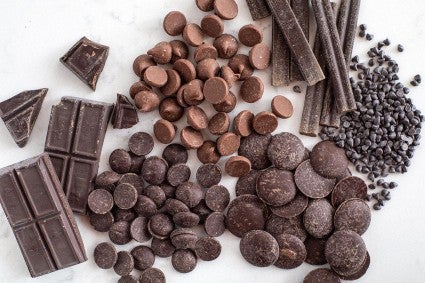
Cook the chocolate: Chop the chocolate with a knife or chocolate chipper. Or, utilize our disks, which are already in an easy-to-cook shape and don't need any chopping at all. Information technology's best to accept a pretty healthy amount: at least a pound to kickoff with. 2 is better. The more book you have, the better it volition hold the temperature where you need it to stay to be workable.
Jenn Bakos
Information technology's typical for chocolatiers to piece of work with ten-pound batches at a fourth dimension. Tempering a movie-size bar of Special Night is possible, but information technology'south going to be tricky, because its temperature is going to fluctuate wildly and, bluntly, in this process, every single caste counts. At that place'southward not plenty thermal mass in that small-scale an corporeality to stay at one temperature for seconds, much less the minutes you'll want for working with it.
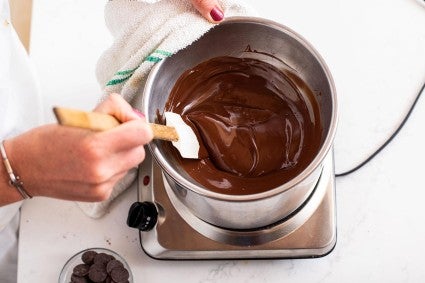
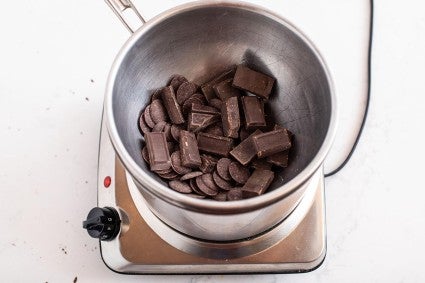
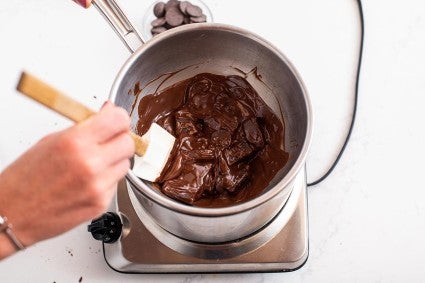
Place the chocolate in a basin and put it over simmering water, or microwave information technology at half power in short (xxx-second) bursts, stirring in between. At that place will come a point where your chocolate is partly melted, with shiny-looking chunks that haven't lost their shape. That's about every bit far as you want to go, because yous can melt it the rest of the way just by stirring. Your goal is to get all the different types of crystals melted and the chocolate to smooth liquid, with no lumps. Have the chocolate's temperature.
- For bittersweet or semisweet chocolate, your goal is 122°F/fifty°C on the first melt.
- For milk or white chocolate, your goal is 105°F/xl°C on the first melt.
Jenn Bakos
Ii important things to avoid: Scorching (microwave); and getting any h2o in the chocolate (simmering water). Both of these things will ruin your chocolate and you'll have to kickoff over. Water in melted chocolate "seizes" it, causing instant recrystallization – not in a skillful way. The chocolate will exist unworkable.
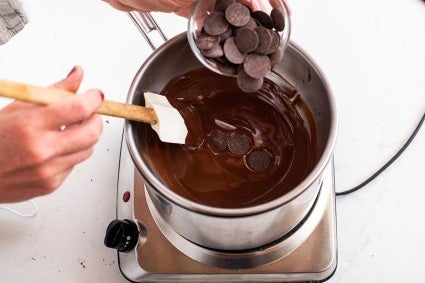
Seeding: One time your chocolate has reached the specified temperature, add a good-sized chunk of chocolate ("cake seeding") or some more chopped chocolate to your lovely pool of melted chocolate. The stable crystals in this new addition encourage stable crystal formations in the melted chocolate. Stirring becomes very important here, considering agitating the chocolate ensures smaller crystals will course and stay in pause.
Jenn Bakos
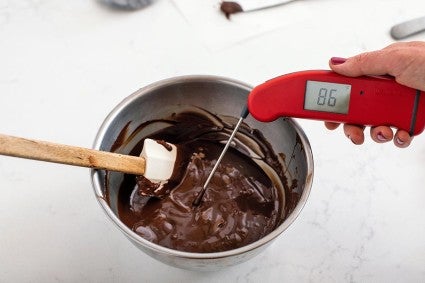
Absurd: Stir continuously until the chocolate is at or below 90°F/32°C; as low as 86°F/thirty°C for dark chocolate or 84°F/28.9°C for milk or white. Every chocolate has its own "sugariness spot" for this, and yous almost have to learn the personality of individual brands and types. I'll tell you right now, it takes longer than yous want information technology to. You take to be at peace with the process considering information technology takes what it takes.
Jenn Bakos
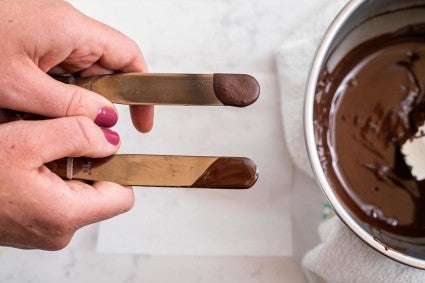
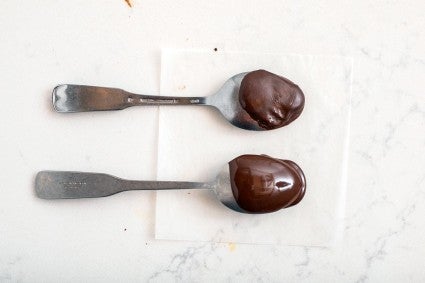
Test: Dip a knife, spoon, or spatula into the chocolate and set it down at cool room temperature (65°F to 70°F). If the chocolate is in temper it will harden quite apace (within iii to 5 minutes) and become firm and shiny. If you touch information technology, your finger will come away make clean.
Jenn Bakos
If the chocolate is as well absurd or out of temper, it volition frequently set in streaks or wait lumpy, like this:
Jenn Bakos
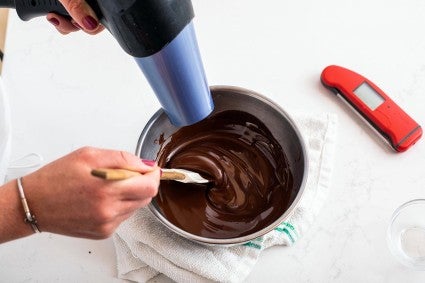
Agree at working temperature and dip away: Most chocolate is easiest to work with between 88°F to xc°F. Yous can put your bowl over another bowl of warm h2o, put it on a folded towel over a very low heating pad, or even try using a mug warmer. As you lot piece of work with it, the chocolate may cool down; to bring information technology back up to a better working temperature, endeavour grabbing your hair dryer and warming the chocolate with it, stirring the whole time. You'll take the best results if whatever you're dipping is close to the temperature of your working chocolate. Every bit chocolate sets it contracts – which is one reason information technology pops out of molds easily.
Jenn Bakos
Think of what y'all can do with your lovely, tempered chocolate. Envelop berries in a coat of dark chocolate.

Liz Neily
Tempered chocolate can also exist used to coat all kinds of cookies, including flaky, pastry-similar rye palmiers.

Liz Neily
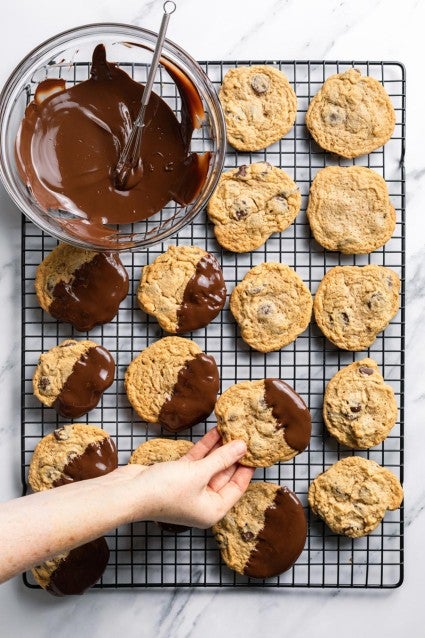
It tin also be used to dress up everyday cookies, like peanut butter chocolate fleck.
Mary Lagier
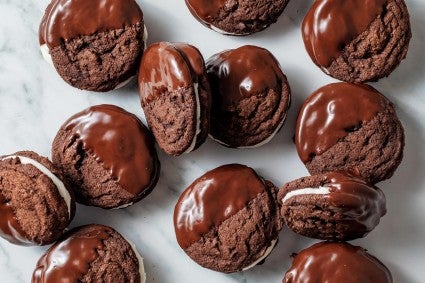
Or utilise tempered chocolate to accept an already decadent dessert over the top. Dunk chocolate desserts (like these Chocolate Peppermint Dips) into tempered chocolate to ensure a seal of approval from anybody.
Mary Lagier
Tempering tips to remember
When the chocolate is right and it's performing its miracle in front of your optics, information technology'south just the greatest feeling. If you're fascinated and want to give this a become, here are a few things to remember.
- The chocolate wins. Always. You demand to work on its terms, non yours. Dry, cool days are adept for your first try.
- Don't try to blitz; make sure you have a few hours to devote to the task.
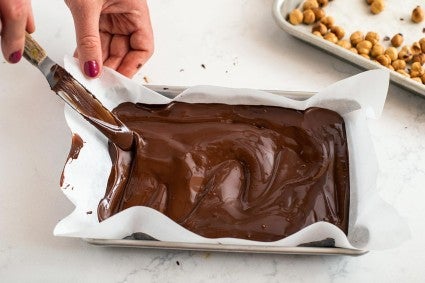
- The leftover chocolate can turned into ganache or sauce, chopped to put in cookies or brownies, or re-tempered and used to make homemade candy bars or chocolate bark.
Jenn Bakos
The side by side fourth dimension you're gazing longingly at the case in a chocolate shop, requite a nod to the patience, talent, and dedication of the people who fabricated each of those beautiful chocolates past hand.
Practice you have more questions about tempering chocolate? Inquire away in the comments below!
Source: https://www.kingarthurbaking.com/blog/2014/01/31/a-basic-guide-to-tempering-chocolate
0 Response to "If You Melt Baking Chocolate Will It Harden Up Again After"
ارسال یک نظر